






The Hidden Economics of Yard Dwell Time
Supply chain leaders have spent a decade making the warehouse intelligent. Slotting, pick paths, labor management, and real-time inventory are now table stakes. Yet just outside the dock doors sits a part of the operation that most companies still run the way they did twenty years ago: the yard. It's the handoff between transportation and the warehouse and it's quietly one of the most expensive blind spots in the network.
The economics of waiting
Start with the number that should get every operator's attention. According to the American Transportation Research Institute (ATRI), driver detention now costs the U.S. trucking industry an estimated $15.1 billion a year about $11.5 billion in lost productivity and $3.6 billion in added costs. Detention is simply the time a truck spends at a shipper or receiver beyond a reasonable window, and the standard definition is any dwell longer than two hours.
It is not a rare event. ATRI's 2024 survey found drivers were detained on 39.3% of deliveries nearly four in ten stops and closer to 56% for refrigerated freight. In for-hire trucking alone, detention consumed more than 135 million driver-hours in 2023. And the cost isn't only financial: a U.S. DOT Office of Inspector General study found that every 15-minute increase in average dwell time raises the expected truck crash rate by roughly 6.2%.
The cost of an invisible yard
The $15 billion figure is only the part that shows up on an invoice. The rest hides in the day-to-day. Every manual gate check. Every misplaced trailer and the walk to find it. Every radio call to confirm what's where. Every paper BoL re-keyed by hand. Individually they're rounding errors. Together they're one of the largest sources of avoidable operating cost in modern logistics and because no single one is big enough to notice, most operations never add them up.
Reverse even a slice of it and the math moves quickly. Shaving 10–15 minutes off average dwell per trailer may sound trivial, but compounded across thousands of moves a month it translates into lower detention charges, better dock utilization, and more throughput from the same footprint without pouring a single acre of new pavement.
The ripple effect
A detained trailer is never a contained problem. Every extra minute compounds:
- Production schedules slip when inbound materials arrive late to the line.
- Dock operations stall as doors sit idle waiting on trailers no one can locate.
- Carriers lose confidence in your appointment windows and price that risk into future rates.
- Drivers burn Hours-of-Service clocks sitting still, tightening already-scarce capacity.
One delayed trailer at 9 a.m. can cascade into missed dock slots, overtime, and expedited freight by the end of the shift. The yard is where those delays are born and where they're cheapest to prevent.
Why the yard is still a blind spot
If the cost is this clear, why does the problem persist? Because the yard has resisted the tools that fixed everything around it:
- Manual, paper-based gate processes. A guard, a clipboard, and a radio can't scale and every keystroke is a chance for error and delay.
- Siloed yard management systems. Many YMS platforms track appointments and moves, but rely on humans to tell them what's actually happening on the ground.
- Disconnected cameras. Most yards already have cameras, but they record for forensics they don't understand what they're seeing in real time.
- Multiple entry points and sprawling footprints. A single yard can span millions of square feet with several gates, making manual visibility almost impossible.
- Labor shortages and rising trailer volumes. There are fewer people to walk the lot, and more trailers to track, every year.
The result is a yard that runs on tribal knowledge and best guesses accurate right up until the moment something moves.
What 'good' looks like
Picture a different arrival. A truck reaches the gate at 8:02 a.m. A camera reads the license plate and USDOT number and captures the Bill of Lading no clipboard, no line. Inventory reconciliation begins before the trailer is even parked. The driver is directed to a specific slot, the trailer's condition is documented automatically, and the yard's live map updates the instant it moves. By the time the trailer reaches its door, the system already knows what's on it and where it needs to go.
That's the difference between a yard that records the past and a yard that understands the present.
Traditional yard vs. Vision AI-powered yard
| Traditional yard | Vision AI-powered yard |
|---|---|
| Manual gate logs and radio calls | Automated gate check-in plate, USDOT and BoL read on arrival |
| Spreadsheet inventory, out of date the moment it's saved | Live trailer inventory the yard becomes the source of truth |
| Trailers found by walking the lot | Slot-level visibility in real time |
| Manual, subjective damage checks | Automated damage detection at entry and exit |
| Reactive firefighting | Proactive flow management |
From visibility to intelligence
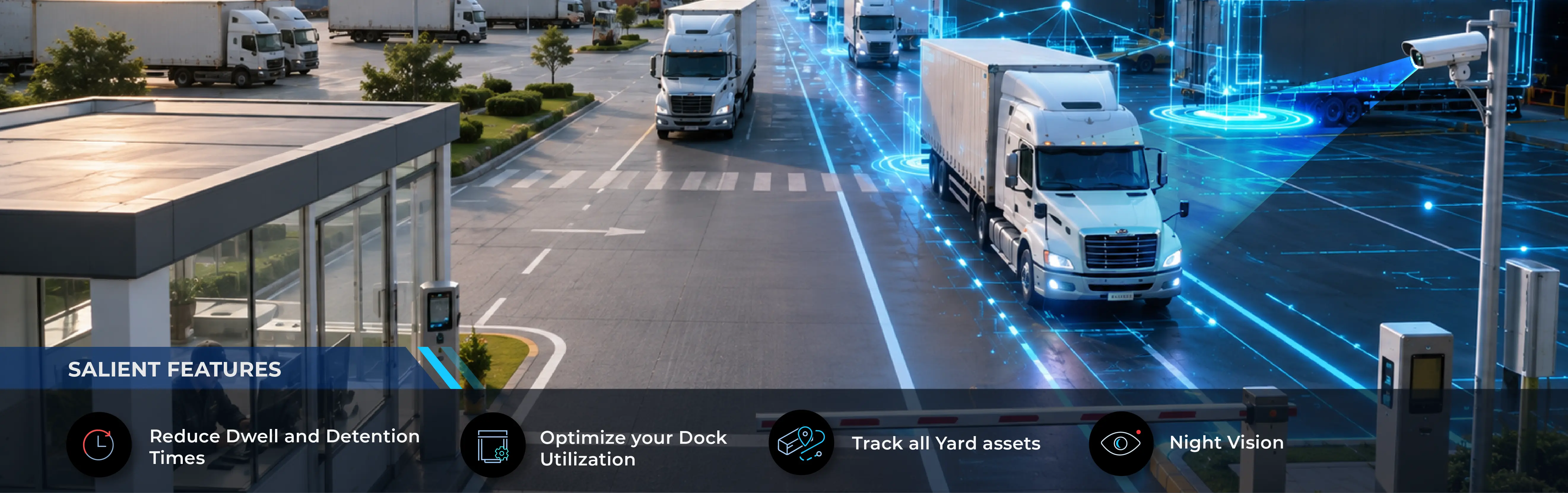
The shift that finally closes the gap is Physical AI computer vision applied to the physical world of the gate, the lane, and the dock. Physical AI doesn't replace people; it replaces manual observation. The cameras already mounted across your site stop being forensic tools you review after something goes wrong and start generating operational intelligence in real time. The yard becomes continuously aware of every vehicle, trailer, and movement a live system of record instead of a place you reconstruct from memory. This is precisely where a traditional YMS falls short: it can hold the plan, but it can't see the ground.
This is the approach KoiReader has taken. KoiReader Yard Intelligence combines automated gate check-in, slot-level visibility, live trailer tracking, automated trailer inspection, and native YMS integration AI yard management that works end to end rather than one feature at a time, feeding accurate, real-time yard visibility into the dock operations and supply-chain systems teams already run.
Proof at scale
It's already running in production. One of the world's leading automotive manufacturers deployed KoiReader across more than seven million square feet of yard operations. Before, gate processing leaned on manual checks and radio calls, and locating a trailer often meant someone walking the lot. Today, every arriving truck is identified automatically, documents are captured at the gate, trailer movements are tracked in real time, and inspections are recorded digitally from entry to exit.
The bottom line
The warehouse became intelligent. Production became intelligent. Yet many yards still operate the way they did two decades ago the analog seam between two highly optimized systems.
The next competitive advantage in supply chain operations won't come from optimizing the warehouse again. It'll come from finally making the yard as intelligent as everything around it.


KoiVision® is the Logistics, Supply Chain, and Industrial Automation Newsletter where we highlight how you can reimagine operations through Deep Tech Insights.
Written by
Padmaja Santhanam
Director of Marketing, KoiReader Technologies
Dated