





The Insight Deficit in Yards That Leaders Can No Longer Ignore
The Hidden Blind Spot in Supply Chains
Ask most supply chain leaders where their biggest operational risks lie, and you will hear about supplier disruptions, port congestion, or last-mile complexity. Rarely does the yard come up. Yet there it sits, a few acres of asphalt connecting inbound freight to outbound fulfilment quietly absorbing delays, accumulating inefficiencies, and eroding margins with almost no executive attention.
The yard is not a passive waiting area. It is a dynamic interchange where transportation schedules collide with warehouse demand, where assets sit idle or go missing, and where the gap between what is planned and what is actually happening widens by the hour. An operator-dependent data capture approach for YMS often results in delayed updates, inconsistent records, and limited real-time visibility across yard operations.
The Insight Deficit in Yard Operations
Walk into the yard office of almost any large distribution operation and you will find a familiar scene: a whiteboard covered in trailer numbers, a radio crackling with instructions, and a spreadsheet last updated three hours ago. This is the operational backbone of a function that handles millions of pounds in inventory movement every single week.
The insight deficit is not a technology problem at its root but structural one. Yard operations evolved as an extension of manual warehouse and transport coordination, and in many organisations, the systems have simply not kept pace with the complexity. Decisions get made on memory, gut feel, and incomplete information. By the time a discrepancy surfaces, the cost has already been incurred.
How confident are you, right now, in the accuracy of your yard inventory?
Operational Red Flags Leaders Often Miss
Here are the signals most operations leaders are not catching early enough:
- Trailer dwell time - Trailers sitting beyond their planned window are a direct cost driver. Detention charges, carrier dissatisfaction, and asset under-utilisation all trace back to a simple failure: not knowing where a trailer is, what it contains, and when it needs to move.
- Yard congestion - Without sequenced slot allocation and real-time position data, yards become gridlocked. Trucks queue, dock doors are occupied by trailers that should have departed hours ago, and inbound freight backs up before it ever reaches the warehouse.
- Asset misplacement - Trailers, dollies, and yard equipment go missing in plain sight. A yard team searching for an asset spends time that should be spent moving freight. Multiply that across dozens of daily movements and the labour drain becomes significant.
- Coordination delays between yard and warehouse - Warehouse teams depend on yard teams for accurate, timely updates. When those updates travel via radio call or manual log entry, the latency compounds. Dock scheduling breaks down. Labour is deployed to doors that are not ready.
- Absence of real-time decision support - Leaders are making operational calls based on reports generated hours earlier. In a fast-moving yard environment, that lag is the difference between a smooth shift and a costly one.
Why Traditional YMS or Manual Methods Fall Short
Legacy yard management systems were built for a different era. Their core function was to digitise what had previously been done on paper like check-ins, check-outs, door assignments, carrier arrivals. In that narrow sense, many of them succeed. But digitising paperwork is not the same as generating operational intelligence.
Manual methods are even more fragile. The moment a coordinator changes shift, institutional knowledge walks out the door. Radio communication creates no audit trail. Spreadsheets are static by nature. None of these approaches scale and none of them give leadership the visibility needed to intervene before a problem becomes a cost.
What would change in your operation if you had a real-time view of every asset, movement, and decision in your yard?
How KoiReader Is Redefining Yard Intelligence
We believe operational excellence requires modernisation, so we built the intelligence layer and orchestration engine that eliminates margin erosion and boosts profitability.
Powered by Vision AI (the eyes), Digital Twins (the operational context), and Agentic AI (the action).
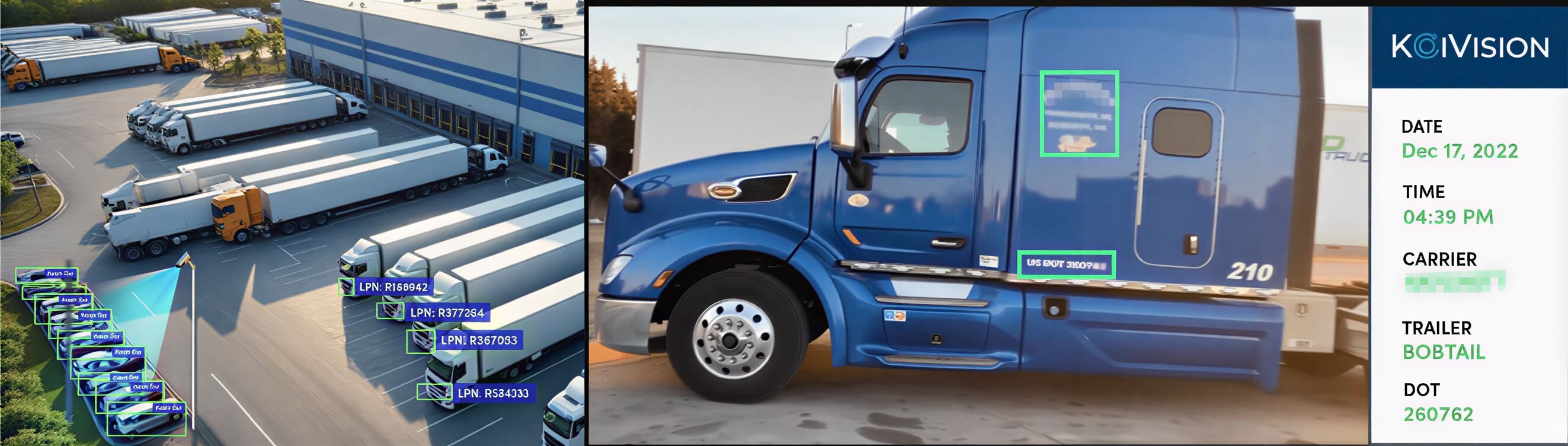
The KoiVision® platform delivers operations intelligence combining vision AI tracking, digital twin simulation, and agentic orchestration for enhanced accuracy and efficiency.
Key innovations include:
- KoiGuardTM - Autonomous guard checks using Vision AI for secure and automated gate operations.
- KoiKioskTM & KoiDriverTM - Digital driver engagement for faster check-ins and streamlined yard entry.
- KoiRoverTM - AI-powered tracking of trailers and yard assets without RFID or GPS sensors.
- KoiDockTM - AI-powered tracking of trailers and yard assets without RFID or GPS sensors.
- KoiGPTTM - Industrial engineering insights that convert operational data into actionable intelligence.
We have delivered multi-million-dollar savings across multiple sites through our solutions, unlocking significant efficiency gains for a Fortune 50 automobile manufacturer.
To discover how similar outcomes can be achieved for your operations:


KoiVision® is the Logistics, Supply Chain, and Industrial Automation Newsletter where we highlight how you can reimagine operations through Deep Tech Insights.
Written by
Hemdeep Ray
Senior Director, Marketing & Pre-Sales
Dated